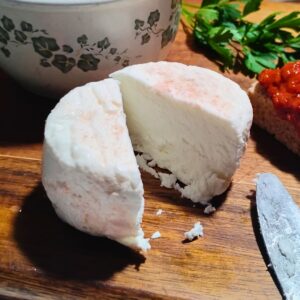
How To Make The Best Soft Feta Cheese

Soft Feta cheese is a culinary delicacy that's so easy to make at home. Here you'll learn how to make delicious soft feta from scratch naturally, with wild fermentation.
Equipment
- A large 6 quart stainless steel pot - for culturing your cheese if you're making a one gallon batch. For a two gallon batch, use a 12 quart stock pot
- Draining baskets - purchased, or use cottage cheese or yogurt containers with holes poked into it. (from the inside out()
- Stainless steel wire rack - this is to set your draining baskets on. Put over the sink or over a large roasting pan.
- 2 quart size mason jars with lids - You'll need one to mix the brine and one to layer your cheeses for brine-curing. That one needs to have a wide mouth opening.
- Long frosting or bread knife - - To cut the curd.
- thermometer
- Skimmer - optional. My favorite tool for stirring and ladling cheese, or use a spoon or a slotted turner.
- Stainless steel ladle or large measuring cup - For scooping the curd and filling your drainage containers.
- Measuring cups and spoons - Use these to measure out the starter culture, rennet, and salt.
- Flowersack towel or fly screen - optional but helpful for keeping flying insects out of your cheeses.
Ingredients
- 1 Gallon raw milk - or pasteurized milk but not ultra-pasteurized.
- ¼ cup cheese starter culture - Use your choice of raw milk clabber, kefir, cultured buttermilk, whey from a previous batch of cheese, or cheese culture made with sourdough starter or fermentation juice or a freeze-dried mesophilic culture.
- un-chlorinated water
- 1/16 tsp single strength rennet (use a scant ⅛ tsp if you don't have a 1/16) - I recommend Walcoren kid or sheep rennet paste or tablets (use 1/16 tablet for this). Dissolve or dilute in ¼ cup of un-chlorinated water.
- ¼ cup sea salt plus extra for drying the feta chunks - use only additive-free salt.
Optional:
- ¼ tsp Calcium chloride - mostly for use with pasteurized milk. Dilute in ¼ cup of un-chlorinated water.
- 1/16 tsp Lipase powder - optional for a more piquante flavor. Be sure to hydrate for about half an hour in ¼ cup of un-chlorinated water before you start mixing your ingredients.
- Sushi mats or dehydrator rack with fine mesh insert or a basket - This would help with drying the cheese after draining for extra airflow.
Instructions
Heat the milk and add the extras
- If you are using lipase powder, sprinkle it into a 1/4 cup of water, stir, and let it hydrate for half an hour before using it.
- Pour the milk into the large pot and slowly warm it to 90 degrees, stirring occasionally. If you're using raw goats or sheep milk, 85 degrees is best. If you're using fresh milk straight from the animals, you don't need to heat it.
- Dilute the calcium chloride with 1/4 cup of water and stir it into the warm milk with an up and down motion.
- Stir the diluted Lipase into the warm milk.
- Add the starter culture to the warm milk and stir well.
- Mix the rennet with 1/4 cup of non-chlorinated water to dilute.
- Add the rennet to the milk and mix using 15-20 strokes in an up-down motion, try to stay below the milk surface with your utensil. After 15-20 strokes, use your spoon to stop the milk from moving. Put a lid on the pot and wrap it in a large, thick towel.
Incubate
- Keep the pot in a warm place for 12-24 hours to incubate.
Drain the curds
- Next day, check on your cheese. Your milk should have clabbered and it should be firm enough to cut cleanly with a knife, and break apart cleanly at the cut site. This is called a clean break.
- Use a long pastry or other knife and cut a criss cross pattern with lines about 1-2 inches apart. Let the curd rest for a moment while you gather your draining equipment.
- Set up your draining station and grab your clean draining baskets. Set everything nearby on the counter.
- With a ladle or a large measuring cup, scoop slices of the curd from your pot and place them gently into one of the draining baskets. Fill the basket all the way to the top. I hold the basket right over the pot and let the whey run back into it while I fill the basket.
- Repeat for all the baskets. After you're done, grab the first basket and top it off and do so with the rest of the baskets. Keep doing that until all your curd is used.
- Pour some of the remaining whey into one of the glass mason jars and fill it. Set aside the pot with the remaining whey for other uses.
- Arrange all your baskets on the draining rack. If you're working with the no-sink method, dump out the whey in the lasagna pan if necessary. (It's a little tricky, but you can figure out a way. I just place the rack on my whey pot for a moment, dump the whey out of the lasagna pan and into the pot and put everything back together for more draining time. CAREFUL when moving the rack with all your baskets on it, they slide oh so easily. Don't tell me I didn't warn you!!)
- I would place a flyscreen over your setup or a light flowersack towel or something to keep any fruit flies or other critters from landing on your precious feta cakes.
- Let the cakes drain for about 12 hours. Then, very carefully flip them and put them back into the forms and drain another 12-24 hours. Once firm, carefully take them out of the forms and place them on some draining mats, a platter or something. If you have a dehydrator, you can use the rack with the thin perforated plastic mat that came with it. This would make a great surface to allow for a bit of airflow and easier drainage. Or use a basket or sushi mat for extra drainage. You can also use a wooden board to dry them on.
Prepare the brine and salt the cheese chunks.
- Now let's prepare the brine. Place ¼ cup of salt into the quart jars with the whey in it. If there is a layer of cream swimming on top, skim it off first. Put a lid on the jar and shake vigorously to dissolve the salt. It's ok if it won't all dissolve right away, just give it another shake whenever you happen to think about it over the next day.
- Here is the important part: The brine and the cheese need to age at the same temperature for the same amount of time. This takes care of all the important things that make a perfect brine and allow for successful brining of the cheese later. The calcium content in the whey is just what is needed to keep the cheese from melting later when it is aging in it. The acidity also must be the same and when you age the brine and the cheese at the same temperature for the same amount of time, the acidity will match. Soo… after mixing your brine, set the jar next to the cheese cakes and keep it there until you're ready to put the cheese in it. (If you are doubling this recipe, make 2 quarts of the brine!)
- Now the cakes need to be salted.
- First look at them to see if they would fit into your canning jar opening. If they are too big, cut the cakes into quarters. Sprinkle with plenty of salt all over all the surfaces and place them on the plate or rack to drain. It's important to cut them before salting because all the surfaces need to dry and form a rind.
- After 12 hours, flip each of them over onto a dry surface and salt them again lightly. The goal is to develop the beginnings of a firmed-up 'rind' all around the exposed edges. This is important to prevent the pieces from dissolving in the brine.
- Let them dry for another 12-24 hours, flipping once or twice more and placing them on a dry surface each time. It might take another day, up to 3 days total.
- Once your feta chunks are firmed up a bit, it's time to age them. Take the second mason jar and carefully place the chunks of cheese into it.
- Now carefully pour the brine down the sides of the jar (don't pour directly on the cheese). Fill the jar all the way up to the top. The chunks need to be submerged. Any that float to the top will most likely get moldy and might become ruined. So place a glass fermentation weight on the chunks, or a boiled flat rock, a broken chopstick, or some other non-corrosive object to keep the cheese down in the brine.
- Now you'll want to age the cheese for 2 weeks at 50 degrees if you have a cheese cave, then move them to a 40 degree or below refrigerator. Or just put it in the fridge right away. It will still taste great. Let the cheese chunks age there for 6-8 weeks. If you want to eat some sooner it's totally fine, they are ok to eat now, but will need some time to mature into real feta. And they get better as they age! Allow for some to ripen for 6 months and compare the difference.
- Whenever you want to eat a chunk, use a clean utensil and lift a piece out of the brine, make sure there are no floaters, and seal the jar back up. Don't put the piece you took out back later, just keep it in a separate container in the fridge and eat it within a week.
Storage
- You'll be storing the feta chunks in the brine for as long as you want until they get eaten. I have had some 3 year old feta and it tasted phenomenal, however this soft feta might not hold together as well as a pressed feta would. So you'll have to experiment on how long yours will last. If it starts to get softer or melt, I'd try to eat it up quickly, because it might be dissolving before long. I have not had that happen before, but it could.
- This brine is not shelf stable at room temperature, although you could keep it in a cold 50℉ root cellar or cheese cave if you have it. I have done that for a few years, but you'll want to keep an eye on it. If it starts to get soft or stuff starts to want to grow on it, I'd rebottle it, place a fresh lid on it, and put it in the fridge till it's used up.
- One of the traditional reasons for brining feta, was because there was no refrigeration and this was a way to keep the cheeses preserved in a warm environment. However, the brines that are used for shelf-stable feta are much saltier than this one. You'd have to make a 26% brine to keep the cheese preserved at room temperature. The brine we made today was only a 7% salt brine.
- In the countries where feta style cheeses originated, they were brined in the 26% solution at room temperature and the cheese would be soaked in clean water for a while to reduce the saltiness before eating it.
- I prefer the 7% salt brine and storing it at cellar or fridge temps.
Notes
Tips For Making The Best Soft Feta Cheese From Scratch
- If you have access to raw milk from pasture raised animals, use that. It's so much better for your health and it makes the best cheese. Plus you've got the material for the best starter culture for cheese making. Goat's or sheep's milk will give you that distinct flavor of traditional feta, while cow's milk will be much milder. If you want the cleanest milk, choose milk from grass-fed animals that graze on unsprayed pastures or have been supplemented with organic grains. 100% grass-fed is best, but hard to find in the dairy world. I supplement with small amounts of organic grain when feeding my goats, for extra energy, since the pastures and grasses here are not very nutritious. If you buy milk, I'd go for organic milk but be careful, because all the organic milk in my local stores are ultra-pasteurized and that doesn't work for cheesemaking.
- If you can't get raw milk, you'll need to be sure that the milk you choose is pasteurized and NOT ultra-pasteurized. Ultra-pasteurized milk will not coagulate with rennet, and won't work for anything other than soft spreadable cheese.
- Cheese needs to have warm room temperatures to culture and drain properly. Go for about 72-85 degrees if you can. Wrap your pot well in a thick towel during incubation.
- Be sure to follow my brine-making instructions carefully. Feta cheese can fail if your brine does not have the correct acidity, salt content, temperature, or calcium content. The brine recipe is just as important as the cheese recipe. Fortunately it is actually super easy, you just need to follow a few rules.
- Calcium chloride should be added to pasteurized milk. If you have trouble getting pasteurized milk to set up, you might want to add a dose of calcium chloride. Unfortunately pasteurization doesn't just kill the beneficial microbes in the milk, but also denatures calcium and proteins. Adding a little calcium chloride will help bring the calcium levels back up to where they should be and this will strengthen the curd. This is not needed when you use raw milk! Raw milk is perfect on its own, however, it can increase the yield for making cheese.
- Lipase powder is very optional. If you're using cow's milk, you'll lack that stronger piquant flavor that goat or sheep milk impart on the feta. You might prefer the milder flavor, but if you would rather experience the bold flavor of goat and sheep milk feta, you can help your cow's milk a little by adding some lipase powder at the time you're adding the culture. Be sure to hydrate it first. Lipase powder is animal based in most cases, but can be microbial as well. It is not normally made with GMOs
Rennet
Use organic animal rennet if possible. Avoid "Vegetable" or "microbial" rennet also called Fermentation Produced Chymosin (FPC). In the U.S. it is most often made with genetically modified organisms, molds, or fungi that are lab-grown on GMO soy or corn bases. In fact, 80-90% of cheese you buy in the store is made with genetically modified, manufactured microbial rennet. Regular animal rennet is most often clean, but can also be made with genetically altered or manufactured materials, and the label does not need to reveal any of this. Honestly, I'd stick with organic or at least a non-GMO product. My go-to rennet is from Walcoren. It's made the old-fashioned, traditional way from kid or sheep abomasum and it's all natural and organic. You can find it in liquid or tablet form. I use the Walcoren Organic Kid Rennet and they also make Lamb Rennet. I have had mine for years and it still works. One jar will last a very long time in your refrigerator and if you plan to make cheese regularly, it's a must-have item. Another option is this clean-ingredient, no-GMO animal rennet. It's a high quality rennet in smaller size bottle and therefore cheaper. I have used this for many years in the past. Aged cheeses are best made with animal rennet and not vegetable rennet, since vegetable rennet can impart off-flavors as the cheese ages. If you must go with vegetable rennet you can try a thistle based rennet that is made with clean ingredients, or make your own from bull thistle stamen, but be aware that your cheese might turn out bitter, especially if you use cow's milk or age your cheese for more than a couple of months. Here is an Organic Microbial Vegetable Rennet, which is lab made and fungus based, that you could try.Starter Culture Options
There are many natural options for starter cultures for this cheese and I'm adding a non-GMO purchased option in case you prefer purchased cultures- If you have access to raw milk, you can make clabber, turn it into a mesophilic culture (medium temperature loving starter culture), and use that to make soft feta cheese. Learn how to do that in my Natural Cheesemaking Process article it's very easy.
- Whey: If you've been making cheese, just use some of your latest whey from your last cheesemaking project.
- Kefir: If you're keeping milk kefir grains, you can use your milk kefir as a starter culture. It is what I used for years.
- Buttermilk: You could buy some cultured buttermilk from the grocery and use it (be sure it contains live bacteria).
- Make cheese starter from either sourdough or fermentation juice as described in How To Make Cheese Culture From Sourdough this requires that you have an active sourdough or any raw fermented food in your fridge. Or take a few days and make some! You basically need to capture some wild live lacto-bacilli and introduce it to pasteurized milk, which is dead milk and needs some help to acidify and come back to life.
- Finally, if you prefer to use purchased, freeze dried cultures, you can use a small sprinkle of Flora Danica, which is non-GMO. Use only a quarter dose of what is recommended for making cheese.
How To Use Soft Feta Cheese
Soft feta cheese is perfect as a topping for salads and other cold dishes. It might melt into hot soups, which is great to make a soup cremay, but if you want chunks in your soups and other hot dishes, or pizza, the firmer Sirene feta would be better suited. But soft feta is great on a baked potato because of its creaminess, and it would be great on a hot sandwich too if you don't mind it a bit melty. Soft feta is perfect when served with savory dips and scooped up with pita bread or crackers. Soft feta is great whipped with some olive oil and served as a dip, or a topping. Use soft feta in any blended feta recipes such as salad dressings. It is great for making a filling in savory baked goods such as hot-pockets or layered in greek savory pastries and similar dishes.Enjoy Your Awesome Soft Feta Cheese!
I sure hope that you will give this delicious cheese a try, and I think you'll love it. It is basically like a chevre cheese, with a little extra rennet to make it more firm and then it is aged in brine. You'll find many ways to use it. I love a slice of fried Kamut bread with a thick layer of ajvar and a generous slice or sprinkle of soft feta, and it makes fresh or fermented tabouli salad or creamy cucumber salad taste incredibly awesome!Shop This Post
Equipment
- Royal Berkey water filter unit
- A large 6 qt pot
- 12 quart stock pot for larger batches
- Flour Sack Towels
- Organic Flour Sack Towels
- Skimmer
- Thermometer
- Long Frosting Knife
- Measuring Cups
- Micro Measuring spoons
- A set of basket forms
- Quart Mason Jar
- Micro Measuring Spoons
- Glass Fermentation Weight
- Mesh Food Covers
- Sushi Mats
Ingredients
- Redmond's Real Salt
- Himalayan Pink Salt
- Celtic Sea Salt
- Walcoren Organic Kid Rennet
- Walcoren Kid Rennet Tablets
- Walcoren Lamb Rennet
- Animal Rennet
- Vegetable Rennet
- Live Kefir Grains
- Flora Danica
- Calcium Chloride
- Lipase Powder
Recommended literature for Cheese making
- The Art Of Natural Cheese Making, David Asher
- Milk Into Cheese, David Asher