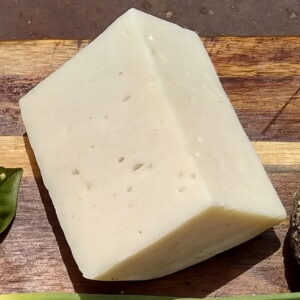
How To Make Bel Paese Cheese From Scratch With Raw Goat's Milk

Bel Paese Cheese is a delicious semi-soft slicing cheese that can be made without a cheese press and ripened and aged in the refrigerator.
Equipment
- 2 12-quart stock pots - One will be used to mix and culture the cheese. The other is for draining the cheese.
- colander - I use this to place my draining basket into. It sits deep in my 12 quart pot where I can keep a cozy warm and humid environment for the Bel Paese during the draining phase.
- Cheese form - If you have a small cheese press form, you'll have a perfect size for this approx 5"x5". If not, you can easily create a form by being a bit creative.
- Follower - optional. This is what covers the cheese and will be used to hold a little jar with warm whey on it.
- Butter muslin - you'll need a piece under the cheese form and maybe as a cheese form liner if necessary.
- Thick bath towel - for wrapping your pot to keep it warm, or fill a sink with warm water.
- Pint canning jar with lid - I use this to pour some warm whey into it and rest it on top of the follower. It helps keep the cheese warm from above during the draining and weighs it down a bit.
- Skimmer - optional.
- thermometer
- Glass container for brining - optional if you choose to brine
- Half gallon jar - for saving the saturated brine later
- Rack or wooden board - for drying the cheese
Ingredients
- 2 gallons Raw goats milk - if you're using pasteurized milk, be sure to not use ultra-pasteurized. It won't work.
- ½ cup Starter culture - Use your raw milk clabber or whey from your last raw milk cheesemaking project. Alternatively use yogurt with live cultures, kefir, or starter culture made with sourdough or vegetable fermentation juice. See 'starter culture' section in the notes for more info!
- ¼ tsp Animal Rennet - for pasteurized milk, use 1/2 tsp rennet! Find more detail in the 'rennet' section in the notes.
- ¼ cup Non-chlorinated water - this is needed to dilute the rennet.
- ½ tsp Calcium chloride, optional! - Not needed for raw milk this is only necessary for pasteurized milk. This is also diluted in 1/4 cup of non-chlorinated water before adding.
For A Super-Saturated Brine
- 2 quarts Warm fresh whey
- 4 cups Sea salt - with no additives!
To Salt Your Cheese Instead of Brining
- 2 tbsp Sea Salt or more as needed. - choose this if you don't want to make a brine
Instructions
- Heat the raw milk slowly to 102-105 degrees while stirring occasionally. (108 degrees if its pasteurized or if it's cow's milk). Take it off the heat.
- Prepare the brining jar by pouring the 4 cups of salt into it. Set it aside for later.
Mixing The Ingredients And Incubation
- Add the culture to the milk and stir it in thoroughly
- If you're using calcium chloride, dilute it and add it now.
- Dilute the rennet in a quarter cup of water. Pour it into the milk and stir well for about 15-20 up and down strokes. Then stop and use your spoon to still the moving milk.
- Cover the pot and let it incubate for 40 minutes. Ideally you'll be holding the temperature, so keep it in a warm place and wrap it in a large, thick towel. If you have a sink, you can fill it with 105-110 degree warm water to keep your pot of milk warm after heating it. Add hot water to maintain the temperature as needed.
- After 40 minutes, check the curd. Is it thick? Stick a knife in it and see if it breaks cleanly. If so, it's time to cut the curd. Otherwise let it incubate another 10-15 minutes.
Cutting The Curd And Cooking The Cheese
- With a long knife cut lines about 2" apart all the way down to the bottom of the pot. Then cut perpendicular lines 2" apart all the way to the bottom.
- Let the curd rest for about 10 minutes.
- Cut the curd into smaller pieces, just criss cross diagonally or between the old lines, to make them much smaller. Another option is to use a wire whisk. Use it in a straight up and down motion across the whole pot.
- Let them heal for 10 minutes and then use a skimmer to cut across below the surface, going down in circular strokes to basically slice layers into the curd strands. This can also be done with a wire whisk held sideways. Your goal is to make 3/8" or pea-sized pieces.
- Now heat the curds up to 102 degrees (108 for pasteurized) very slowly, by adding hot water to the sink or placing it on a burner with low heat. Using a double boiler method is safer to avoid overheating the curds at the bottom, if you have a large pot to set your cheese pot into.
- Stir every few minutes while heating to keep the curd from sticking together and matting on the bottom and to keep the curds away from the direct heat of the burner below.
- After 20-30 minutes of stirring (your temperature should be 102 (108) degrees now, test to see if they will stay matted together in a clump when compressed with your hand. They should stick together, but still be easy to separate with your fingers. If they don't stick, keep stirring till they do.
- Take the pot off the heat and let the curds settle for 5 minutes while you prepare your draining station.
Draining The Cheese
- Grab your second pot and colander. Set the cheese form into the colander. Place a piece of butter muslin under it to prevent the curd from squeezing through the holes of the colander and set it aside.
- Use one of two methods to proceed:
Method 1
- After the 5 minutes are up, pour the whey out into the second pot careful and don't let the matted curds slide out too.
- Once most of the whey is poured out, reserve 2 quarts of the whey to make the brine and pour it into the glass jar over the salt to mix later, when you have a moment.
- Now place the colander with the cheese form into the pot with the whey.
- Quickly grab handfuls of the curd and place them into the form to drain. They must stay warm.
Method 2
- Line your empty second pot with a large cheesecloth.
- Carefully pour the whey and curds from the first pot into the cheesecloth of the second pot. Use your hand to support the curd and keep it from making a big splash when it slides into the second pot with the whey.
- Set the colander with the mold into the now empty pot.
- Grab the cheesecloth by the corners, lift the curds out of the whey and squeeze the whole package into your prepared cheese mold inside the colander that you placed over the first pot.
Proceed For Both Methods
- If you have a follower, place it over the curd right away and a pint jar filled with warm whey to press on it lightly and to keep the curd warm. Then I cover it all with a heavy towel or an upside down bowl to keep it warm and humid inside.
- Place this pot on a heat source and lightly heat the whey in it to 110-120 degrees while your curd is draining in the colander above it.
- After 10 minutes, flip the cheese loaf over, replace the follower, weight, lid and towel or bowl.Keep an eye on the temperature of the whey below. Don't let it get too hot. Once it hits 120 degrees, turn off the heat and just let it sit until the whey cools a bit before turning the heat back on.
- Flip the cheese half an hour later for the second time. It should start to look pretty smooth except for the imprint of the basket pattern. If you used a cheesecloth liner, you can get rid of it now.
- Flip again every 30 minutes for the next hour and a half. After that just flip it every 1-2 hours.
- You don't need to use the weight after the first 2 hours if you were using it at all.
Brining Or Salting
- After about 7 hours, your cheese can go into the brine. If it's evening, just let it drain in the form till the next morning and brine it in the morning.
- Brining: Find a cool place for brining.
- Place the cheese into the glass container with the brine and sprinkle salt over the top. Flip it after 3 hours. Ideally, you'll brine it for 4 hours per pound of cheese, but you don't need to weigh it, just call it 7 hours of brining for this 2 gallon size and flip it once or twice in the brine. Always salt the surface that's exposed due to floating. This will also add some salt back into your brine to keep it saturated. If you find some gadget to keep the cheese from floating, you don't need to salt the top.
- Salting: If you don't want to make the brine, you can also salt the cheese by sprinkling generously with salt all over. Flip it after 3 hours and salt it all again. After another 4 hours, wipe it off.
- Dry the cheese until it's dry to the touch for a day or two on a rack or wooden board and cover with a fly tent or a tea towel. Flip it occasionally.
Ripen the cheese
- Once it's dry, it goes into the fridge to mature. Put it on a wooden board, or on some type of rack or cheese mat inside a plastic or glass container with some room to breathe.
- Flip it once a day for a week, then every two days for the next few weeks. If moisture builds up inside the container, wipe it dry.
- After 2 weeks your Bel Paese will get a bit greasy on the surface. Wipe that off with salted whey, vinegar, or wine.
- If it get's moldy, just wipe off the mold, and again use salted whey, vinegar or wine to do so.
- After 2 weeks you can taste it, but I'd wait for a month to eat it. Slice some off and enjoy.
Storage
- This cheese can be stored and aged. It's great after 2-4 weeks and you can go ahead and use it in whatever dishes you want or slice it to make sandwiches. I love to eat slices of it for a snack. It's awesome with crackers or for grilled cheese sandwiches too.
- If you have extra, you can opt to age it for months or years in the fridge, cheese cave, or cellar, and for that you have a few options:
A) Encourage a natural rind
- One is to just keep it in it's container or on a fridge rack uncovered, and wipe it off a couple of times each week to keep mold from growing on it. This will encourage a natural rind to form. If you keep it uncovered, it will get more dry eventually.
B) Vacuum packing
- Another option is to vacuum pack it. This is what I use currently, but it is frowned upon by purists, and not the best option if you're trying to reduce your use of plastic.
- Anyway, I find it so hard to keep a close watch on the cheese once it's in that fridge. And vacuum packing makes it easy to keep the cheese mold-free. It is similar to waxing and easy to do with a vaccuum sealer. Just double check the seal to make sure it is going to stay sealed up. If air gets into it, it will get moldy.
- When you're ready to eat some, cut the bag open, remove what you want and reseal the bag. Undoubtedly it's the easiest, low maintenance aging method.
C) Waxing The Cheese
- Your next option is waxing. Be sure to find a non-toxic cheese wax. My recommendation is pure organic beeswax.
- Heat the wax in a pot, dip half of the cheese into it, let it harden, dip the other half in, let it harden and repeat. Or you can brush the wax on. You will need less wax for this method.
- Once waxed, you can keep it on a shelf in the fridge till you want to use it.
- At that time, slice off a piece and reseal the cheese by dipping the cut side into warm wax a couple of times.
- If you like waxing the cheese, I'd get a cheap second crock pot (I find them at thrift stores quite often) and keep the wax in it, ready to heat when you need it. Or get an old pot and dedicate it. The wax can be reused. Always be vigilant when heating wax to not overheat it and cause it to combust.
- I have stored some of my vacuum packed Bel Paese cheese for about 3 years in a root cellar and it was delicious. I can't imagine that it wouldn't be fine even longer, but have not tried it. It can also be kept in a cold cellar or cheese cave. Cheese cave temperature is generally 50-55℉.
Notes
Tips To Make The Best Bel Paese Cheese At Home
- If you're using Pasteurized milk, I recommend that you add calcium chloride to your milk. Pasteurization not only kills the good bacteria, but it also breaks the calcium in the milk and denatures proteins. For best results, add some calcium back in to provide better structure and cohesiveness in the curd. It can also improve the yield of any milk, but it is not necessary for raw milk.
- Flip your cheese shortly after pouring it into the mold. I like to flip mine for the first time after 10 minutes for a better texture in the cheese. After that every half hour for the next 2 hours and then once or twice more.
- Flip the cheese after it goes into the refrigerator to age once a day for a week and then about 2-3 times for the week thereafter. Once it develops a greasy film, wipe it with salted brine, vinegar or wine every few days. It's good to eat after 2 weeks, but it's best to wait about a month. For long term storage, I vacuum pack my cheese, but you can also wax it. Then stash it away in your fridge. Turn it once every few weeks.
- This cheese gets brined after forming and draining. If you prefer, you can just salt it, because it's so small. That means covering it generously with salt on all the surfaces, flipping after a few hours and reapplying salt. You can do this overnight.
- I prefer using a saturated brine, because your brine can be reused over and over. Make it once and just keep using it. You will waste less salt and it makes less mess. I pour my brine into a quart canning jar and keep it in the fridge. Seasoned cheesemakers keep their brine for decades and claim it gets better and it becomes somewhat of a prized possession, much like an aged sourdough starter. It takes a lot of salt, but as long as you don't dump it out, it's not wasted. If you'll never make cheese again, use this salt solution by the spoonful and add it as seasoning to bread, baked goods, soup, marinades, etc.
- My instructions call for 2 gallons of milk. That is my favorite amount of milk for this cheese. While you could make it with 1 gallon, it's really not worth all the trouble and cheese ages better when the loaf is bigger. You could make it bigger, but I find that it's more convenient to have smaller loafs of this in the fridge for stashing and for using. 8 gallon batches make some huge loafs that are a bit hard to find room for when you don't have a root cellar!
Rennet
Use organic animal rennet if possible. Avoid "Vegetable" or "microbial" rennet also called Fermentation Produced Chymosin (FPC). In the U.S. cheese is most often made with genetically modified organisms, molds, or fungi that are lab-grown on GMO soy or corn bases. In fact, 80-90% of cheese you buy in the store is made with genetically modified, manufactured microbial rennet. Regular animal rennet is most often clean, but can also be made with genetically altered or manufactured materials, and the label does not need to reveal any of this. Honestly, I'd stick with organic or at least a non-GMO product. My go-to rennet is from Walcoren. It's made the old-fashioned, traditional way from kid or sheep abomasum and it's all natural and organic. You can find it in liquid or tablet form. I use the Walcoren Organic Kid Rennet and they also make Lamb Rennet. I have had mine for years and it still works. One jar will last a very long time in your refrigerator and if you plan to make cheese regularly, it's a must-have item. Another option is this clean-ingredient, no-GMO animal rennet. It's a high quality rennet in a smaller size bottle and therefore cheaper. I have used this for many years in the past before I found Walcoren. Aged cheeses are best made with animal rennet and not vegetable rennet, since vegetable rennet can impart off-flavors as the cheese ages. If you must go with vegetable rennet you can try a thistle based rennet that is made with clean ingredients, or make your own from bull thistle stamen, but be aware that your cheese might turn out bitter, especially if you use cow's milk or age your cheese for more than a couple of months. Here is an Organic Microbial Vegetable Rennet, which is lab made and fungus based, but not GMO. It has some good reviews. If you're using pasteurized milk, increase the rennet to 1/2 tsp!Starter Culture
Raw Milk Options
There are natural options for starter cultures to make Bel Paese Cheese. Bel Paese is normally made with part thermophilic, part mesophilic cultures. If you have clabber culture from raw milk, you don't have to worry about any of that. It contains all the microbes you need that will work in warmer and medium temperatures naturally. The gist of making raw milk starter culture: Just let a pint of your raw milk clabber, use a spoonful of that to inoculate another pint of fresh, raw milk, repeat and after 3-4 rounds, you'll have a clabber culture that you can use to start cheese with. To get more details about this process, check out this Natural Cheesemaking Process article. And you can learn more about making Clabber here. Whey: If you made cheese before with raw milk starter, you can also use the unsalted whey from a previous batch of cultured cheese. Raw milk clabber whey is what I use.If you don't have access to raw milk
Whey: If you've been making cheese, just use some of your latest whey from your last cultured cheesemaking project. If it is a raw milk whey or yogurt whey you're good to go. If you used mesophilic cultures in a previous cheese, then I would also add some yogurt to make this cheese along with your whey, use half the amount of each. Kefir: If you're keeping milk kefir grains, you can use your milk kefir as a starter culture. It is what I used for years and it contains both mesophilic and thermophilic microbes. Yogurt: You could buy some cultured plain yogurt from the grocery and use it (be sure it contains live bacteria). Make cheese starter from either sourdough or fermentation juice as described in How To Make Cheese Culture From Sourdough. This requires that you have an Active Sourdough or any Raw Fermented Food in your fridge. Or take a few days and make some! You basically need to capture some wild live lacto-bacilli and introduce them to the pasteurized milk after growing them on raw food or flour, which is what you do with sourdough and fermented vegetables. Pasteurized milk is dead milk and needs some help to come back to life. I have tried making this cheese with culture made from Fermentation Juice Starter and pasteurized milk and it came out really nice but with lots of holes, sort of what you get when using Kefir. It tastes wonderful after a month of aging. Stay tuned to find out how well it ages over a longer term. I'm also working on a sourdough starter version. My first batch did not turn out so well and I think that was because I forgot to add calcium chloride to the pasteurized milk and I let it get a little too warm at one point. I do have a cheese from this test, but I haveHow To Use Bel Paese Cheese
It's great in hot panini and foccacia sandwiches. Try it in a grilled cheese sandwich. Use it like Provolone cheese in cold italian sandwiches or any cold-cut sandwiches. Grate it and use it on or in casseroles. Use in place of mozzarella on pizza or pasta. Eat as a snack by itself. Try it fried as cheese sticks, like mozzarella sticks.Enjoy Your Delicious Bel Paese Cheese, The Beautiful Country Cheese!
I hope you get to make this and I'd love to hear about it. And I sure hope you'll love this cheese as much as I do. It is easy to make and when I want to make a hard cheese but don't want to bother with a lot of fussing, I always make this one.Shop This Post
Equipment
- Royal Berkey water filter unit
- 12 quart stock pot for larger batches, two is better or you can wing it with one.
- Flour Sack Towels
- Organic Flour Sack Towels
- Skimmer
- Thermometer
- Long Frosting Knife
- Measuring Cups
- Micro Measuring spoons
- Quart Mason Jar
- Micro Measuring Spoons
- Small cheesemold with follower
- Glass Fermentation Weight
- Organic Beeswax from Azure Standard
- Vacuum Sealer with bags
Ingredients
- Redmond's Real Salt
- Himalayan Pink Salt
- Celtic Sea Salt
- Walcoren Organic Kid Rennet
- Walcoren Kid Rennet Tablets
- Walcoren Lamb Rennet
- Animal Rennet
- Vegetable Rennet
- Live Kefir Grains
- Calcium Chloride
Recommended literature for Cheese making
- The Art Of Natural Cheese Making, David Asher
- Milk Into Cheese, David Asher